Permit for fire-hazardous work in an Ex zone. When is it required and how to issue it correctly?
Not all hazards in Ex zones are visible at first glance. Sometimes all it takes is one grind, one cut, one ignition – and not only the work is over, but also the safety of the entire facility. Fire-hazardous work is an everyday occurrence in many industrial plants. But what about explosion-hazardous zones? There, every spark counts twice.
The problem is that the issue of permits is still often overlooked. Either the procedure is “business as usual”, regardless of the location and type of work. Or everyone hopes that “nothing will happen”. Except that… it only takes one time for something to happen.
When do fire-hazardous works require a permit? Don’t guess – there are specific criteria.
A permit for fire-hazardous work is always required when open flames or sparks are used in a place where there is a risk of ignition. This is not a matter of discretion – it is a matter of regulation and logic.
The most common examples of situations that always require a permit to be issued:
📝 Read more: Big Bags in the Ex zone – types A, B, C or D, and why can a single mistake lead to an explosion?
Provide your company with a risk assessment that genuinely improves security.
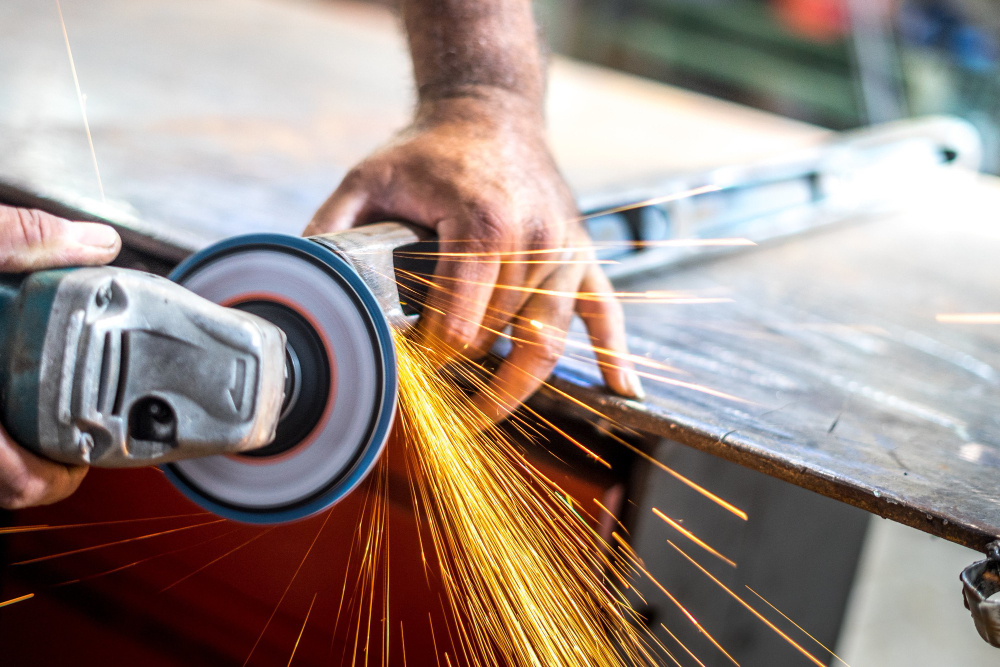
- welding, thermal cutting, grinding within the Ex zone,
- renovation work using tools that generate sparks,
- activities performed near flammable substances, tanks, gas pipelines, solvents, even if the fire itself is temporary.
In many cases, employees assume that if the work takes only a “moment” or is performed outside the building, permission is not necessary. This is a mistake. The key factor is not how long the work takes, but whether it could cause ignition or spread fire. And in an Ex zone, it doesn’t take much.
It is also worth remembering that not having a permit is not only a procedural error, but also a violation of health and safety regulations, which may have legal consequences. For the workplace, for the supervisor, for the contractor.
List of fire-hazardous works – check what really needs to be on the list
Not all jobs are obvious. It is clear that welding or cutting with a blowtorch requires special measures. But what about grinding? Moving steel elements? Drilling holes for anchors?
The list of fire-hazardous works should include all activities that may:
- generate open flames or sparks,
- heat surfaces to the ignition temperature of substances present in the vicinity,
- generate combustible dust or lead to leaks in the gas/fuel system.
Typical examples that are often overlooked:
- work using diamond and grinding tools,
- cleaning tanks after combustible substances,
- cutting materials near cables or tanks,
- metalworking using high-speed tools.
The list should not only be up to date, but also tailored to the specific nature of the plant – it cannot be a generic document copied from the internet. It is worth updating and approving it periodically, preferably in cooperation with the person responsible for health and safety and the coordinator of work in Ex zones.
How to issue a permit for fire-hazardous work and avoid getting into trouble during an inspection?
A permit is not just a piece of paper with a signature – it is a legal document that must contain specific information, provisions and safeguards. In the event of an incident, it is the first thing to be checked.
What must be included in a well-prepared permit?
- detailed description of the location and scope of work,
- start and end times (specified in detail),
- a list of names of persons performing the work and the supervising person,
- list of safety measures in place (fire extinguishers, curtains, gas concentration monitoring, etc.),
- conditions for safely resuming work after a break,
- date, signatures, internal permit number (if applicable).
The permit should be stored and available for inspection for a specified period of time, in accordance with company policy – usually a minimum of 12 months. In the case of ATEX audits, external inspections or accidents, this is the first document that the inspector will look for.
Some companies use ready-made templates – this is fine, as long as they contain all the required fields and are adapted to specific conditions. Important: the document must be issued before work begins. No “we’ll fill it in later” will be accepted.
A permit is not just a piece of paper with a signature – it is a legal document. And since we are talking about the required forms, it is worth exploring the topic of the Explosion Protection Document (EPD). See what it should contain, who issues it and when it is necessary.
Fire safety measures for hazardous work – what must be implemented before work commences?
Before the first spark falls, everything must be prepared. In Ex zones, there is no room for spontaneous decisions, makeshift safety measures or “adapting as you go”.
🔍 See also: Not everything that produces dust is safe – how to interpret Kst and Pmax indicators in practice?
This is not bureaucracy – it is a practice designed to genuinely reduce the risk of ignition.
Before commencing any fire-hazardous work, the following minimum requirements should be implemented:
- cutting off the supply of utilities (gas, steam, compressed air) in the work area,
- removal of flammable materials within a radius of at least 10 m or their protection with non-flammable covers,
- securing technological openings (channels, grilles, gaps),
- providing fire-fighting equipment – appropriate for the type of hazard and immediately available,
- checking for the presence of explosive atmospheres before and during work (e.g. gas detectors),
- appointment of a supervisor – physically present throughout the entire duration of the work.
In some cases, certified Ex equipment may also be required, e.g. non-sparking tools, wireless detectors or explosion-proof radio communication.
It is also important to check all safety measures after completing the work – including immediately after completion. Experience shows that most fires following hot work occur several minutes or even hours after completion.
Before the first spark is ignited, everything must be prepared. If you would like to explore the topic of ignition conditions and the minimum energy required for ignition, please visit our blog.
Who is responsible for fire-hazardous work? Not only the person who signed the consent form.
Responsibility for fire-hazardous work is dispersed – and this is intentional. For the safety system to function, each participant must know their tasks, powers and limits of decision-making.
The most common mistake? Assuming that once the consent form has been signed, the rest will “take care of itself”.
Meanwhile, in practice:
- The person issuing the permit is responsible for risk assessment, the correctness of documentation and the conditions for commencing work.
- The contractor is obliged to comply with the arrangements and instructions, wear the required protective equipment and report any irregularities.
- The coordinator or supervisor (e.g. health and safety representative, technologist, maintenance engineer) must check that the work complies with the permit and, if necessary, suspend it.
Importantly, responsibility does not end when the consent form is signed. If a fire or explosion occurs after the work is completed, the inspector (or prosecutor) will analyse, among other things:
- who supervised the site after the work was completed,
- whether the fire was the result of negligence in security measures,
- whether employees followed the instructions.
In short: signing is just the beginning. Responsibility continues until the risk is completely eliminated.
Each participant in this process has their own task. And if you are interested in the entire range of possible explosion protection measures — from HRD systems to earthing — read the linked articles, which cover this topic in detail.
What regulations concerning fire-hazardous work do you need to know in order to sleep peacefully?
The regulatory framework is clear – but how it is applied in practice makes all the difference. Knowledge of the regulations is the foundation that allows you not only to operate legally, but above all – safely.
📝 Read more: Layer of Protection Analysis – When Safeguards in an Installation Are Not Enough and How to Detect It
The most important legal acts regulating the performance of fire-hazardous work in Ex zones are listed below.
- Labour Code (Articles 207 and 226) – employer’s obligations to ensure safe working conditions.
- Regulation of the Minister of Economy of 8 July 2010 – on minimum requirements for occupational health and safety in the use of machinery by employees during work.
- Regulation of the Ministry of Internal Affairs and Administration of 7 June 2010 – on fire protection of buildings, other structures and areas.
- PN-EN 60079-14 standard – concerning the design, selection and installation of electrical systems in Ex zones.
- Company instructions and internal ATEX procedures – every company operating in Ex zones should have its own rules for issuing permits and safety measures.
Ignorance of these regulations does not exempt you from liability. Failure to comply with them may result not only in a fine, but also in criminal consequences in the event of an accident.
It is also worth remembering that fire-hazardous work is often subject to external inspection – e.g. during ATEX audits, PIP inspections or visits by the State Fire Service. In such cases, all documents, procedures and signatures must be in place.
Do not risk signing out of habit! Seek assistance from the professionals at Atex Consulting.
If you issue permits automatically, stop. If you don’t know who is responsible for what when it comes to fire-hazardous work, ask. If you are not sure whether your safety measures are sufficient, check now.
In Ex zones, any work involving sparks is a potential ignition point. That is why the procedure must be realistic, not just on paper. Documents must work, and people must know how to use them.
If you want to be sure that everything is working as it should, write to us. We will help you develop permit templates, create safety lists, train your team and tailor everything to your specific needs.
Frequently asked questions about fire-hazardous work
Does every welding job require a permit for fire-hazardous work?
Yes, regardless of where it takes place. If you are welding near combustible materials, tanks, pipes, indoors or outdoors, you must always have formal permission. In an Ex zone, this is an absolute must.
Who can sign a permit for fire-hazardous work?
This is usually a person authorised by the employer, e.g. a shift manager, maintenance engineer, health and safety specialist or ATEX coordinator. This person must be familiar with the hazards, authorised to make decisions and aware of their responsibilities.
How long is a single permit for fire-hazardous work valid?
Only for the period specified in the document – specific date, specific hours. If the work is interrupted and resumed the next day, a new permit must be issued. It is not permitted to extend it “on your word” or verbally.
Must safety measures for fire-hazardous work always be the same?
No. Safety measures are selected for a specific job, location and risk. In one case, a fireproof mat and a fire extinguisher may suffice. In another, gas detectors will need to be used, utilities disconnected, installations shut down and a buffer zone designated.
Can you use a ready-made authorisation template?
Yes, as long as it meets all the requirements. The finished print is just a tool. The most important thing is that it contains:
personal details,
detailed description of the work and location,
list of safety measures,
conditions for safe working practices,
signatures and dates
What are the consequences of not having a permit for fire-hazardous work?
First and foremost – a real risk of fire or explosion. In addition:
a fine during an inspection by the National Labour Inspectorate or State Fire Service,
professional or criminal liability in the event of an accident,
inability to obtain compensation from insurance,
allegation of gross violation of health and safety regulations.